Artificial intelligence is no longer a futuristic concept reserved for tech giants. It is rapidly becoming the engine behind the most efficient and customer-centric artificial intelligence call centre solutions in the world. When thoughtfully deployed, AI does not replace people; it amplifies what human agents can do, while giving customers faster, more helpful support on the channels they prefer. Businesses looking to optimize their operations can read more about AI-driven support centers and discover how AI-powered virtual agent assist tools enhance customer experiences.
This guide explores how an artificial intelligence call centre works, the benefits it unlocks, and practical steps to get started. The focus is firmly on positive outcomes: happier customers, more motivated agents, and a leaner, more resilient operation.
With modern AI-driven call centres, companies can now leverage advanced distributed computing platforms for large-scale AI tasks to manage data more efficiently and support seamless interactions. Integrating AI into daily workflows allows agents to focus on complex problem-solving while automated systems handle repetitive inquiries. Businesses that implement high-performance computing solutions for AI workloads often see significant improvements in both speed and accuracy of their customer responses.
Moreover, combining AI insights with smart marketing strategies can dramatically enhance customer retention. For example, marketing strategies for improving customer engagement show how AI-generated analytics can guide personalized outreach. Similarly, digital marketing tactics for AI-powered support centers help businesses align their customer service with broader brand campaigns, ensuring consistency across all channels.
Financial operations also benefit when AI is integrated into customer support. Many companies explore top resources for financial planning in AI-driven call centres to make informed investment decisions in AI technology. These insights allow management to allocate budgets more effectively while enhancing the overall quality of service delivered.
In essence, artificial intelligence call centres are not just about technology—they are about creating smarter, faster, and more empathetic experiences for both customers and agents. By combining advanced computing platforms with intelligent customer strategies, businesses can stay ahead in competitive markets while maintaining human-centric service.
Top 10 Artificial Intelligence Call Centre Solutions
When businesses explore ways to enhance customer experiences, optimize agent performance, and streamline operations, selecting the right artificial intelligence call centre solution is critical. Here’s a list of the leading providers in the space, starting with Bright Pattern.
1. Bright Pattern: AI Contact Center Excellence
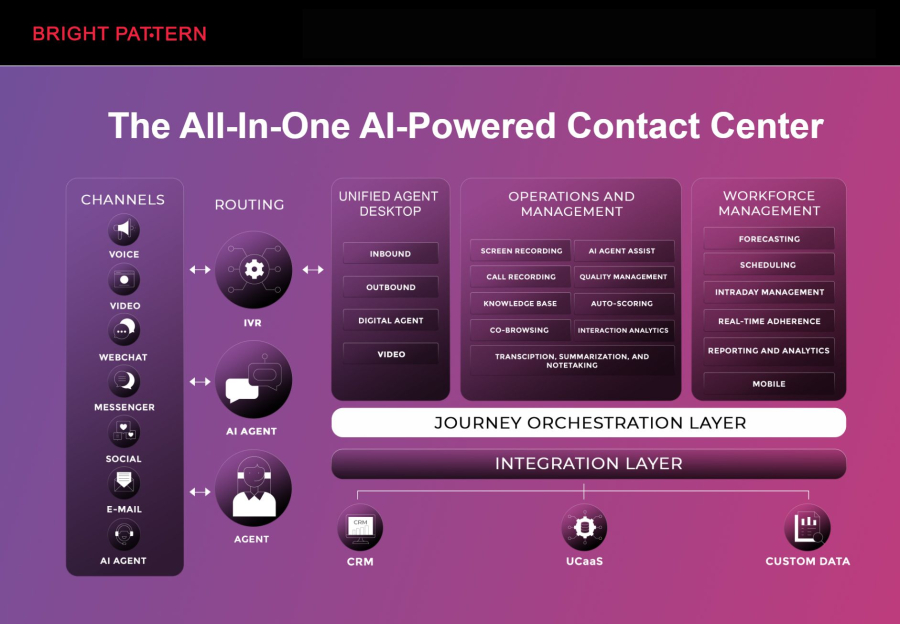
Bright Pattern stands out as a complete AI contact center solution that helps businesses deliver smarter, faster, and more seamless customer interactions. It combines advanced artificial intelligence capabilities with omnichannel communication to transform traditional call centre operations.
Key highlights:
- AI-driven agent assist: Enhances agent productivity by providing real-time suggestions and insights.
- Omnichannel support: Integrates voice, chat, email, and social media channels in one platform.
- Intelligent routing: Ensures customers are connected to the most suitable agent based on context and history.
- Advanced analytics: Tracks performance metrics and customer sentiment to improve service quality.
Bright Pattern’s platform is ideal for organizations looking to implement an artificial intelligence call centre that balances automation and human engagement, helping companies increase efficiency and customer satisfaction.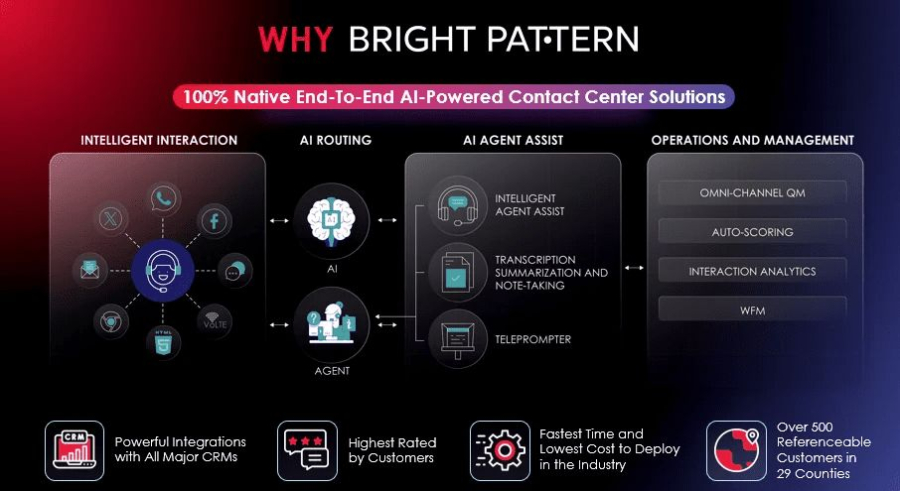
2. Genesys Cloud CX
Genesys Cloud CX offers a comprehensive suite of AI-powered call centre tools. Its strengths lie in predictive routing, automated chatbots, and customer journey analytics, making it a strong contender for enterprises aiming to modernize customer service.
3. Five9 Intelligent Cloud Contact Center
Five9 provides AI-enhanced cloud contact center solutions with automated outbound campaigns, virtual agents, and omnichannel capabilities. It’s widely used for scaling support operations without compromising quality.
4. Talkdesk CX Cloud
Talkdesk combines AI-powered automation with real-time analytics to improve agent efficiency and customer satisfaction. Its AI virtual assistants handle routine inquiries, freeing agents for more complex tasks.
5. NICE CXone
NICE CXone integrates artificial intelligence into a unified platform, offering omnichannel routing, performance management, and predictive analytics to optimize every interaction.
6. Cisco Contact Center AI
Cisco’s AI solutions focus on improving customer engagement through intelligent virtual assistants, speech recognition, and analytics tools designed for enterprise call centres.
7. Avaya OneCloud CCaaS
Avaya OneCloud delivers cloud-based contact center solutions enhanced with AI for routing, workforce optimization, and omnichannel communication, helping organizations deliver consistent service.
8. 8x8 Contact Center
8x8 provides AI-powered cloud contact center solutions that combine voice, chat, and social channels, along with analytics to improve decision-making and service efficiency.
9. RingCentral Contact Center
RingCentral offers an AI-driven platform for omnichannel customer support, enabling automated workflows, sentiment analysis, and real-time performance monitoring.
10. Zendesk Suite
Zendesk integrates AI into its customer support platform, offering virtual agents, workflow automation, and analytics to improve response times and overall customer experience.
What Is an AI-Powered Call Centre?
AnAI-powered call centrecombines traditional telephony and contact centre tools with artificial intelligence technologies such as natural language processing, machine learning, and predictive analytics. Instead of relying solely on menus, scripts, and manual workflows, AI systems understand intent, automate routine tasks, and provide real-time guidance to agents.
In an AI call centre, technologies typically include:
- Virtual agents and chatbotsthat can handle common enquiries through voice or chat.
- Conversational IVRthat lets customers speak naturally instead of navigating complex keypad menus.
- Agent assist toolsthat surface recommendations, next best actions, and knowledge articles during live calls.
- Analytics and quality monitoringthat use AI to identify patterns, issues, and opportunities for improvement.
- Automation and workflowsthat trigger actions in back-office systems without manual intervention.
The result is a call centre that feels smarter, more responsive, and far easier to scale as your business grows.
The Biggest Benefits of an Artificial Intelligence Call Centre
When implemented with a clear strategy, AI can transform both customer and employee experiences. Below are the core benefits organisations typically aim for.
1. Faster Response Times and Shorter Queues
Long hold times are one of the main reasons customers dread contacting support. AI attacks this problem from several angles:
- Virtual agentsresolve common questions instantly, without customers waiting for a human agent.
- Intelligent routingconnects callers to the right agent first time, reducing transfers and re-explanations.
- Automated triagecaptures customer details and intent before passing the call to an agent, so they can start helping immediately.
These improvements combine to bring down average handle time and queue length, leading to a more streamlined experience for customers and a more manageable workload for teams.
2. Always-On, 24/7 Customer Service
Customers now expect support at any time, from any location. Hiring enough staff to run a full, high-quality 24/7 operation can be challenging and expensive. AI provides a more sustainable path to round-the-clock assistance.
- Virtual agentscan operate 24/7, answering common questions, providing updates, and capturing information for follow-up.
- Out-of-hours triageensures urgent issues are prioritised for the next available human agents.
- Self-service journeysallow customers to check orders, reset passwords, or make simple changes without speaking to an agent.
This always-on capability enhances customer satisfaction while keeping staffing requirements focused on times when human expertise truly matters.
3. More Personalised Customer Experiences
AI thrives on data. In an AI call centre, information from customer history, previous interactions, and current behaviour can be analysed in real time to tailor every conversation.
- Customer recognitionallows the system to identify callers and surface relevant details automatically.
- Context-aware responsesmean virtual agents can adapt their answers based on who the customer is and what they have done previously.
- Next best action recommendationshelp agents suggest relevant solutions, upgrades, or support resources suited to each customer.
Personalisation makes customers feel known and valued, turning routine service interactions into stronger, longer-lasting relationships.
4. Happier, More Empowered Human Agents
It is easy to assume that AI is only about automation. In reality, some of the biggest wins come fromaugmenting human agentsso they can do their best work.
- Real-time promptshelp agents navigate complex situations, compliance requirements, and upsell opportunities.
- Knowledge suggestionssurface the most relevant articles or procedures, so agents spend less time searching and more time helping.
- Automated after-call workcan capture notes, outcomes, and next steps, freeing agents from repetitive admin.
When tedious tasks are reduced, agents have more time for problem-solving and building rapport. This typically improves job satisfaction, lowers burnout, and makes it easier to retain top talent.
5. Greater Operational Efficiency and Cost Control
AI enables call centres to do more with the same or fewer resources, without compromising service quality.
- Automation of routine contactsmeans human agents handle a smaller volume of repetitive calls and more of the complex, high-value enquiries.
- Optimised staffinguses forecasts and real-time data to better match demand with available agents.
- Process standardisationthrough AI-driven workflows reduces errors and rework.
Over time, these efficiency gains can make the call centre more cost-effective while also raising performance standards.
6. Consistent Quality and Compliance
Maintaining consistent quality across thousands of calls per day is tough. AI systems can listen, analyse, and flag patterns at a scale that manual quality teams simply cannot match.
- Automated quality monitoringreviews a much larger proportion of calls, not just small samples.
- Compliance checksverify that required phrases, disclosures, or questions are used where necessary.
- Sentiment analysishelps identify frustrated customers or at-risk accounts early.
Leaders gain a clearer view of what is actually happening in their contact centre and can action improvements faster and more confidently.
7. Scalability and Resilience
Call volumes can spike for many reasons, from seasonal peaks to unexpected events. Traditional staffing models can struggle to respond quickly.
- Virtual agentscan scale instantly to handle surges in straightforward calls or chats.
- Dynamic routingcan prioritise high-value or high-risk interactions during busy periods.
- Cloud-based AI tools(where used) support rapid expansion to new locations or teams.
This adaptability makes the entire operation more resilient, even under pressure.
How an AI Call Centre Actually Works
Behind the scenes, an artificial intelligence call centre is powered by a set of complementary technologies working together. Understanding these components can help you plan your own roadmap.
Conversational IVR and Virtual Agents
Conversational IVRreplaces rigid keypad menus with natural language understanding. Instead of “press 1 for sales”, customers can simply say what they need in their own words, and the system detects their intent.
Virtual agentsextend this capability, holding full conversations over voice or chat. They can:
- Answer FAQs.
- Authenticate customers with security questions or one-time codes.
- Provide order updates, appointment details, or account information.
- Capture information needed before handing off to a human agent.
Well-designed virtual agents are transparent about being automated and offer an easy route to a human when needed, ensuring customers feel supported rather than trapped.
Intelligent Routing and Triage
When AI understands what a customer needs, it can make a smarter decision about who should handle the interaction.
- Skill-based routingmatches customers to agents with the right knowledge or language skills.
- Priority routingensures high-value customers or urgent issues are handled first.
- Context sharingpasses transcripts, notes, and intent to the agent so they start with full background.
Customers spend less time repeating themselves, and agents start each interaction better prepared.
AI-Assisted Agents in Real Time
During a live call or chat,agent assist toolsact like a digital co-pilot.
- They listen to or read the conversation, identify topics, and surface relevant knowledge articles.
- They suggest responses or key phrases to keep the interaction compliant and on-brand.
- They can recommend the next best action, such as scheduling a follow-up or offering a particular product.
Agents remain in control of the conversation, but they spend less time searching systems or wondering what to do next.
Analytics, Insights, and Quality Monitoring
AI excels at turning large volumes of unstructured interaction data into actionable insights.
- Speech and text analyticsconvert conversations into searchable transcripts and tag them by topic, sentiment, and outcome.
- Trend detectionreveals emerging issues, common root causes, or bottlenecks in processes.
- Automated scoringhelps quality teams quickly identify calls that need attention or coaching.
These insights support continuous improvement across products, policies, and customer journeys, not just scripts.
Automation and Back-Office Workflows
Finally, AI can trigger and manageautomationbeyond the call itself.
- Updating a CRM record when key details change.
- Creating a support ticket with all necessary information already filled in.
- Initiating follow-up communications such as confirmation messages or surveys.
By connecting the front line with back-office systems, AI helps ensure that promises made to customers are followed through accurately and efficiently.
Real-World Use Cases and Success Scenarios
AI can support a wide range of customer service and sales scenarios. Here are some practical examples across different sectors.
Retail and E-commerce
- Order trackingvia virtual agents that pull real-time delivery updates.
- Returns and exchangesguided through automated journeys that set expectations clearly.
- Product recommendationsoffered to agents based on browsing and purchase history.
Customers get fast, convenient answers, while businesses increase repeat purchases and reduce strain on agents.
Banking and Financial Services
- Account querieshandled securely by conversational IVR and virtual agents.
- Fraud alerts and blockingsupported by automated verification flows and real-time risk analysis.
- Personalised advicewhere agents receive AI-driven prompts to suggest relevant services or tools.
The combination of security, speed, and personalisation helps build trust and loyalty in a highly regulated environment.
Utilities and Public Services
- Outage informationmade readily available through self-service options, reducing call spikes.
- Billing enquiriesresolved quickly with AI-powered guidance and explanations.
- Change of detailssuch as addresses or payment dates automated through guided workflows.
Customers gain more control over their accounts, and organisations ease pressure on contact centres during busy periods.
Telecommunications and Technology
- Technical troubleshootingautomated through step-by-step virtual diagnostics.
- Device or service activationcompleted via guided self-service, with agent backup when needed.
- Proactive outreachtriggered when AI spots signals that a customer may need help or is at risk of leaving.
AI helps convert support interactions into opportunities to impress customers and reduce churn.
Implementing an Artificial Intelligence Call Centre: A Practical Roadmap
Shifting to an AI-powered model does not require a sudden, all-or-nothing transformation. The most successful programmes are phased, focused, and aligned with clear business goals.
Step 1: Define Objectives and Success Measures
Start by clarifying what you want AI to achieve. For example:
- Reduce average handle time.
- Increase first contact resolution.
- Extend support hours without adding headcount.
- Improve customer satisfaction scores.
Clear goals help you choose the right use cases and measure impact over time.
Step 2: Map Customer Journeys and Identify Quick Wins
Analyse your current contacts to understand where AI will have the biggest positive effect.
- Which enquiries are most common and repetitive?
- Where do customers experience delays or frustration?
- Which processes are rule-based and predictable?
These areas often provide quick wins for virtual agents, automation, and agent assist tools.
Step 3: Start Small, Then Scale
Begin with focused pilots rather than trying to automate everything at once.
- Launch a virtual agent for a limited set of FAQs.
- Introduce AI-based knowledge suggestions to a pilot group of agents.
- Test conversational IVR on a specific line or customer segment.
Use feedback and performance data to refine your approach before rolling out more widely.
Step 4: Involve Agents Early and Often
Front-line agents understand customer pain points better than anyone. Involving them in design and testing helps create tools they will actually want to use.
- Gather input on which tasks feel repetitive or time-consuming.
- Co-design prompts, workflows, and knowledge content with experienced agents.
- Offer training that focuses on how AI helps them, not just how it works.
When agents see AI as a partner rather than a threat, adoption and performance both improve.
Step 5: Integrate with Existing Systems
The most effective AI call centres do not operate in isolation. They connect to core systems such as CRM, ticketing platforms, billing systems, and knowledge bases.
Prioritise integrations that:
- Give AI access to accurate, up-to-date data.
- Allow smooth handover between virtual agents and humans.
- Automate routine updates and follow-up tasks.
Strong integration reduces duplication of effort and ensures everyone is working with the same information.
Step 6: Monitor, Learn, and Continuously Improve
AI is not a set-and-forget technology. Models, workflows, and knowledge content all need to evolve as your business and customers change.
- Review analytics regularly to spot new trends and opportunities.
- Update training data to reflect new products, policies, and customer language.
- Gather feedback from customers and agents to guide enhancements.
A culture of ongoing improvement ensures that your AI call centre becomes more effective and more trusted over time.
Key Capabilities to Look For in AI Call Centre Solutions
When evaluating AI tools for your call centre, it helps to have a clear checklist of capabilities that support both short-term wins and long-term growth.
Core Functional Capabilities
- High-quality speech recognitionthat performs well across accents and noisy environments.
- Natural language understandingto identify intent and extract key details from customer speech or text.
- Omnichannel supportacross voice, chat, messaging, and email.
- Configurable workflowsfor routing, triage, and automation.
- Powerful analyticswith dashboards, trend analysis, and drill-down capabilities.
Usability and Agent Experience
- Intuitive interfacesthat agents can use confidently with minimal training.
- Real-time assistancethat is timely, relevant, and non-intrusive.
- Flexible scripts and promptsthat contact centre leaders can update without heavy technical work.
Trust, Security, and Governance
- Robust security controlsfor handling sensitive customer data.
- Clear audit trailsfor quality, compliance, and regulatory requirements.
- Transparent AI behaviourso you can understand and explain key decisions.
Choosing solutions that meet these criteria will help you build a reliable, future-ready AI call centre environment.
The Future of AI in Call Centres
AI in call centres is already delivering tangible benefits, but the journey is far from over. Several trends are shaping the next wave of innovation.
- More natural interactionsas language models become better at understanding nuance, emotion, and context.
- Deeper personalisationpowered by richer data and more advanced customer profiles.
- Proactive servicewhere organisations reach out to customers before they encounter a problem.
- Closer human–AI collaborationwith tools that feel like intelligent colleagues rather than separate systems.
The call centre of the future is not simply a cost centre. It is a strategic hub for customer insight, brand experience, and revenue growth, with AI as a central enabler.
Frequently Asked Questions About AI Call Centres
Will AI replace human call centre agents?
AI is best seen as a complement to human agents, not a replacement. It automates routine interactions and provides intelligent support, so people can focus on complex, relationship-driven work where human judgement and empathy are essential.
How long does it take to see benefits?
Timeframes vary by organisation, but many see early gains when they start with focused use cases such as automating simple FAQs or introducing agent assist tools. The key is to measure results, learn from them, and expand gradually.
Is an AI call centre only for large enterprises?
No. While large enterprises were early adopters, modern AI tools are increasingly accessible to mid-sized and even smaller organisations. Cloud-based solutions, flexible licensing, and pre-built integrations make it easier to start at a manageable scale.
How do customers feel about interacting with AI?
Customer sentiment depends largely on design. When virtual agents are clear about being automated, handle tasks efficiently, and offer an easy path to a human, many customers appreciate the speed and convenience. Poorly designed bots, on the other hand, can quickly create frustration.
Conclusion: Turning Your Call Centre into a Strategic Advantage with AI
Anartificial intelligence call centreis about far more than cost savings or automation. It represents a shift towards smarter, more human experiences at scale, where technology handles the heavy lifting and people focus on what they do best.
By combining conversational AI, intelligent routing, real-time agent assistance, and powerful analytics, organisations can build call centres that are faster, more personal, and more resilient. The result is a win–win: customers feel genuinely cared for, and teams are empowered to deliver their best work every day.
